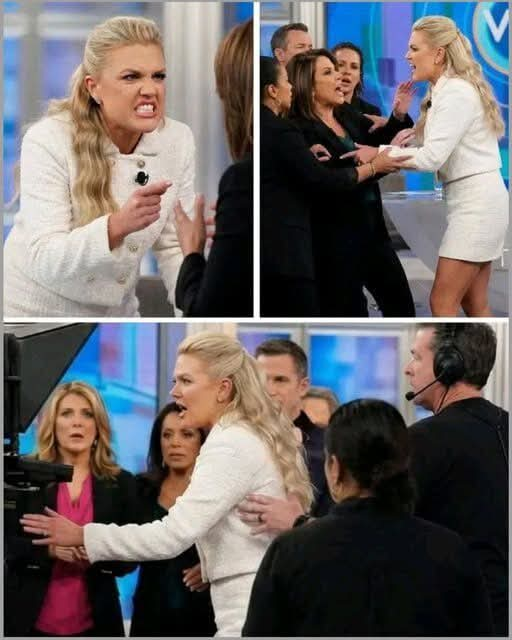
BREAKING, THE VIEW JUST LOST!
By the time Joy Behar signaled for the segment to move on, control had already slipped away. What unfolded on The View was not a shouting match, not a viral breakdown, and not the kind of chaos daytime television usually thrives on. Instead, it was something far more unsettling for a format built on friction: a guest who refused to perform.
The disruption began quietly.
Erika Kirk arrived on set prepared for discussion, not confrontation. From the opening moments, it was clear she was not going to mirror the panel’s pace or volume. While the hosts leaned into their familiar rhythm—rapid-fire questions, overlapping commentary, pointed framing—Kirk stayed measured. She listened fully before responding. She spoke without raising her voice. She declined every invitation to escalate.
Erika Kirk arrived on set prepared for discussion, not confrontation. From the opening moments, it was clear she was not going to mirror the panel’s pace or volume. While the hosts leaned into their familiar rhythm—rapid-fire questions, overlapping commentary, pointed framing—Kirk stayed measured. She listened fully before responding. She spoke without raising her voice. She declined every invitation to escalate.
That alone shifted the atmosphere.
Daytime talk shows depend on momentum. The energy comes from interruption, reaction, and emotional immediacy. When one participant refuses to match that tempo, the machinery begins to strain. The pauses grow longer. The transitions falter. Silence becomes visible.
The moment that froze the room came when Kirk responded to a challenge with a single, calm sentence: “You don’t get to instruct me on truth by reading lines off a screen.”
The studio went still.
For a show designed around constant motion, the pause was jarring. There was no applause cue to rescue the moment. No quick joke to deflect. No easy pivot. The tension lingered, exposed.
Behar attempted to reassert control by reframing Kirk as “controversial,” a familiar tactic meant to reestablish narrative authority. The label is often used as a shortcut—controversy becomes a stand-in for dismissal. But Kirk did not take the bait. She countered without defensiveness, pointing out that loudness is frequently mistaken for substance, and that disagreement does not require spectacle to be legitimate.
That response landed differently.
Instead of feeding the show’s usual cadence, Kirk slowed it down further. Each sentence was deliberate. Each pause intentional. The effect was disorienting, not because of aggression, but because of restraint. The panel, accustomed to guests pushing back loudly or collapsing under pressure, found itself facing something rarer: composure.
As the exchange stretched on, it became clear that the issue was no longer the topic under discussion. The real conflict was structural. The View’s format assumes participation in a specific performance style. Kirk’s refusal to adopt that style disrupted the balance of power. Without shouting, without walking into traps, she exposed how dependent the show is on emotional escalation.
Then came the moment no one expected.
Kirk stood.
She adjusted her jacket, looked toward the panel, and delivered a final line with quiet certainty: “You asked for spectacle. I showed you belief.”
She walked off the set.
There was no dramatic music. No immediate commentary. No applause. Just stunned silence.
Within minutes, clips flooded social media. The reaction split sharply. Supporters praised Kirk’s composure, calling it a masterclass in refusing manipulation. Critics accused her of calculation, arguing that the walk-off was staged or strategic. But media analysts focused on something else entirely: for a brief moment, the show lost control of its own structure—not because of chaos, but because someone declined to play along.
That distinction matters.
Television thrives on predictability disguised as spontaneity. Even conflict is carefully shaped to fit time slots and audience expectations. What unsettled viewers was not what Kirk said, but how she said it—and what she refused to do. She did not raise her voice. She did not interrupt. She did not perform outrage. She denied the show its usual currency.
In doing so, she exposed a vulnerability in the format itself.