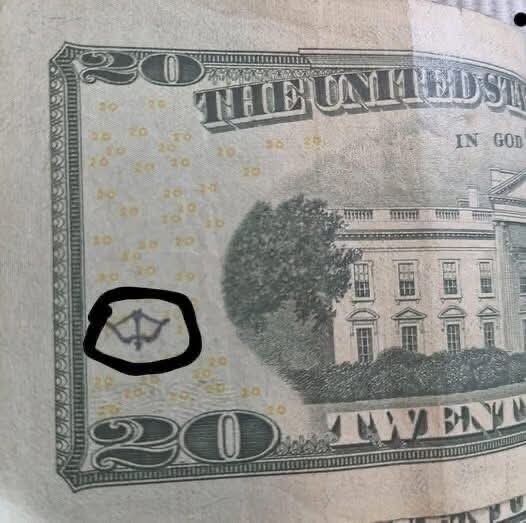
The Real Reason Your $20 Bill Has a Bow-and-Arrow Symbol, How Mysterious Marks on U.S. Currency Reveal Global Trade Routes, Underground Verification Networks, and Centuries-Old Money-Handling Traditions That Continue Today Without Most Americans Realizing It
Most people handle cash without giving it much thought,
glancing at the amount before folding it away.
Occasionally, though, a bill stands out because of an unfamiliar symbol or tiny stamped mark near the
portrait or margin. One common example is a small
bow-and-arrow–like emblem that looks mysterious at first,
raising suspicions of graffiti, codes, or counterfeiting.
In reality, these markings are part of a practice
known as chop marking, a tradition far older than
modern paper currency. Chop marks act as informal
verification stamps, telling a quiet story about
where a bill has traveled and how it was trusted far
from its country of origin. Rather than damage, they signal inspection and acceptance.
The origins of chop marking trace back centuries
to ancient China, where merchants verified silver
coins by testing their weight and purity, then
stamping them with a personal mark. Each stamp
served as a signature of trust. Over time, coins
with multiple chops became more credible, having been verified again and again.
As money evolved from metal to paper, the practice adapted.
Ink stamps replaced punches, especially in regions
where formal banking systems were limited. Because
the U.S. dollar became the world’s most widely accepted
currency, it naturally became the most common target for these marks.
Today, chop marks appear frequently on U.S. bills
circulating in parts of Asia, Africa, and Latin America.
Money changers, vendors, and traders use them as
quick visual confirmation that a bill has already been checked.
The symbols vary widely and carry no secret meaning beyond trust.
Back in the United States, these marked bills are
generally accepted by banks and retain full value.
For collectors and the curious, however, they offer
something more: evidence that an ordinary bill once
moved through distant markets, carrying with it a quiet record of global exchange.